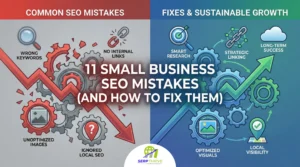
For small businesses, a strong search engine optimization (SEO) strategy is no longer optional. SEO plays a direct role in how visible your business is online, how often potential customers discover you, and ultimately how many leads and sales your website generates through organic search.
Yet, despite its importance, common SEO mistakes that small business owners make unknowingly sabotage their SEO efforts by making avoidable mistakes.
In this article, as I’ll break down small business SEO mistakes, explain why they hurt performance, and share practical ways to fix them so you can build sustainable, long-term growth.
Let’s dive in.
1. Neglecting Keyword Research
One of the biggest SEO mistakes small businesses make is underestimating the importance of keyword research.
Keyword research helps you understand how your potential customers search, what language they use, and what problems they want solved. Without this insight, content creation becomes guesswork.
Many small business owners publish content based on assumptions instead of data. This often leads to:
- Ranking for irrelevant keywords
- Attracting the wrong audience
- Generating traffic that never converts
Keyword research is the foundation of any SEO strategy. It determines what you write, how you structure pages, and which opportunities are realistically achievable.
Why keyword research matters
- Reveals buyer-intent search terms
- Helps you avoid impossible competition
- Guides content length and depth
- Aligns SEO with revenue goals
Yes, keyword research takes time. But skipping it costs far more in wasted effort.
2. Overlooking On-Page SEO
Keyword research and on-page SEO go hand in hand. Without keywords, on-page optimization loses direction.
On-page SEO includes:
- Page titles and meta descriptions
- Headings (H1, H2, H3)
- URL structure
- Internal content flow
- Body copy optimization
Failing to optimize these elements makes it difficult for search engines to understand what your page is about.
Best practices
- Use your primary keyword naturally in the title and H1
- Support it with related terms in subheadings
- Maintain clear content structure
- Avoid keyword stuffing
On-page SEO should feel natural to readers while remaining clear to search engines.
3. Ignoring Internal Link Building
Internal linking is one of the most underused SEO tactics among small businesses.
Internal links help:
- Users discover related content
- Search engines understand site structure
- Important pages gain authority
- Crawl efficiency improves
When internal links are missing, pages become isolated and lose ranking potential.
How to improve internal linking
- Link from blog posts to service pages
- Connect related articles together
- Use descriptive anchor text
- Prioritize your most valuable pages
Once internal linking becomes a habit, it takes very little time but delivers consistent SEO benefits.
4. Forgetting Image SEO
Images improve engagement and readability, but they can also harm SEO if poorly optimized.
Large, uncompressed images slow down page speed, which negatively affects rankings and user experience.
Search engines can’t “see” images. They rely on text signals instead.
Image SEO essentials
- Descriptive file names
- Keyword-relevant alt text
- Compressed file sizes
- Proper image formats (WebP where possible)
Optimized images also help your site appear in Google Image Search, which receives billions of searches every day.
5. Disregarding Local SEO
Local SEO is critical for businesses serving specific geographic areas. Yet many small businesses focus on broad SEO while ignoring their most valuable audience: local customers.
Local searches convert at a much higher rate than generic searches.
Why local SEO matters
- Builds local trust and visibility
- Drives foot traffic and calls
- Aligns with mobile search behavior
- Supports Google Maps rankings
A properly optimized Google Business Profile (GBP) plays a central role here. Accurate business information, regular updates, and customer reviews significantly impact visibility.
6. Failing to Implement Schema Markup
Schema markup helps search engines better understand your website’s content and business details.
It can enhance listings with:
- Business information
- Reviews and ratings
- FAQs
- Product details
These enhancements often appear as rich results, increasing click-through rates.
Many businesses avoid schema because it sounds technical. In reality, modern tools make implementation straightforward.
7. Focusing on Traffic Numbers Alone
Traffic looks impressive on reports, but it doesn’t always translate into revenue.
A common SEO mistake is chasing high traffic keywords without considering intent.
Better focus
- High-intent keywords
- Conversion-focused pages
- Content aligned with buyer stages
Quality traffic that converts is always more valuable than large volumes of irrelevant visitors.
8. Not Tracking Ranking Keywords
Publishing content without tracking performance is like marketing without measurement.
Without tracking:
- You don’t know what’s improving
- You miss optimization opportunities
- Momentum stalls
Keyword tracking allows you to:
- Identify rising pages
- Improve existing rankings
- Respond to competition early
Consistent monitoring ensures SEO efforts continue compounding over time.
9. Missing Google Search Console Insights
Google Search Console (GSC) is one of the most powerful free SEO tools available, yet many small businesses never set it up.
GSC provides insights into:
- Search queries triggering impressions
- Click-through rates
- Indexing issues
- Page performance trends
Ignoring GSC means missing direct feedback from Google itself.
10. Losing Sight of the Long-Term Strategy
SEO is not a quick win channel.
Short-term tactics may deliver temporary gains, but sustainable growth comes from consistency and patience.
A long-term SEO strategy focuses on:
- Continuous content improvement
- Technical health
- Authority building
- User experience
Businesses that treat SEO as a long-term asset consistently outperform those chasing shortcuts.
11. Neglecting AEO & GEO Opportunities (AI-Driven Search Visibility)
One of the most overlooked SEO mistakes small business owners make today is ignoring how search visibility has evolved. In 2026, search is no longer limited to traditional blue links. A growing number of searches are answered directly through AI-powered results.
This includes:
- Google AI Overviews
- Voice search responses
- Generative AI platforms like ChatGPT
If your content isn’t structured for these systems, your website may still rank but never appear as the answer.
What AEO & GEO Mean
- AEO (Answer Engine Optimization) helps search engines extract clear, direct answers from your content.
- GEO (Generative Engine Optimization) helps AI systems understand, trust, and reference your business when generating responses.
Traditional SEO asks:
- Can I rank for this keyword?
AEO and GEO ask:
- Can my content confidently answer the question?
Why Small Businesses Miss Out
- Long paragraphs with no direct answers
- No FAQ sections
- Missing schema markup
- Unclear service, location, or audience
- Overly promotional language
What Works in 2026
- Question-based headings (H2/H3)
- Short, clear answers immediately after questions
- Structured FAQ sections
- Clear business and location signals
Ignoring AEO and GEO doesn’t cause sudden ranking drops, but it slowly reduces visibility in AI-driven search experiences where attention now lives.
Avoid These Mistakes Small Business Owners Make When Using SEO and Build Sustainable Growth
By avoiding the common SEO mistakes outlined above, small businesses can create a strong foundation for long-term organic growth.
Key takeaways
- Keyword research is non-negotiable
- SEO should prioritize intent, not volume
- Local SEO drives real revenue
- Tracking and optimization must be ongoing
- Consistency beats quick wins
SEO rewards clarity, patience, and relevance. When done correctly, it becomes one of the most reliable growth channels available to small businesses.
If you align your strategy with these principles, traffic, leads, and trust follow naturally.